


Most people call us asking about “pressure washing” because that is the name everyone knows. Then they point at the green film on the shaded side of the house, or the dark streaks running down the roof, and ask if we can blast it off. The honest answer is that the right method depends on the surface, and getting that choice wrong is how a cleaning turns into a repair bill. We are a veteran-owned crew rooted in the Fort Bragg community, and we handle pressure washing across the Fayetteville area every week, so this guide walks through which method each part of your home actually needs, what roofing and siding manufacturers say about it, and the cases where we will tell you a wash is not the answer at all.
Soft Washing vs. Pressure Washing: How They Actually Differ
Soft washing cleans with chemistry at low pressure, and pressure washing cleans with the force of high-pressure water, so the two methods belong on completely different surfaces. Soft washing uses a solution of sodium hypochlorite, a surfactant, and water, metered to a percentage set for the surface, then left to dwell before a fresh-water rinse. The solution does the work. Pressure washing sends high-pressure water through a surface cleaner to lift embedded dirt off hard surfaces that can take the force.
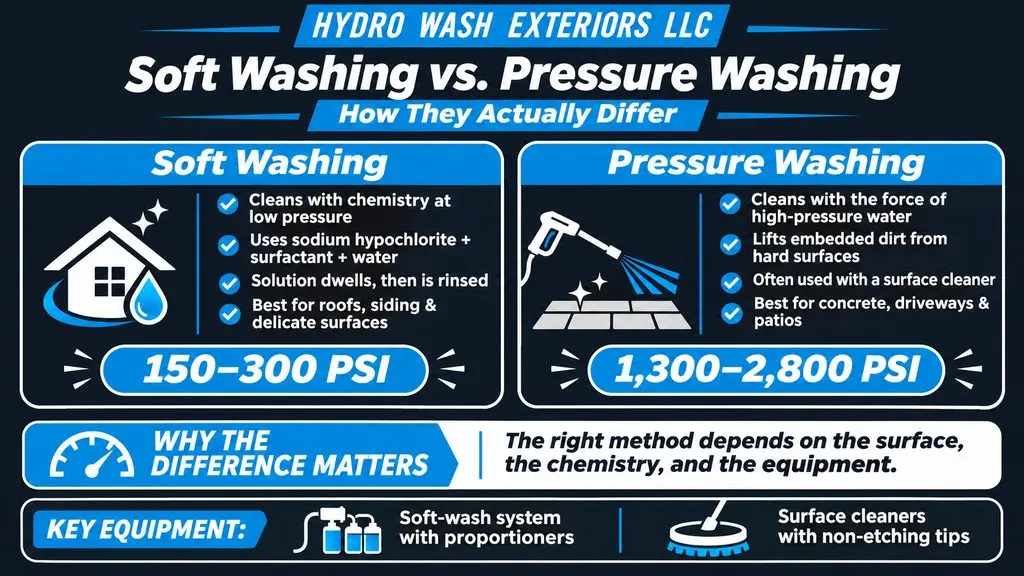
The pressure gap between the two is wide. According to pump manufacturer Pumptec, a typical soft-wash system runs around 150 to 300 PSI, while pressure washing runs roughly 1,300 to 2,800 PSI. That is why “soft” does not mean weak. The low pressure is only possible because the chemistry is doing the cleaning, so we can clear heavy growth off siding without ever putting damaging force against it.
The equipment reflects that split. We run a C3 Skids soft-wash system with proportioners that meter the solution to the right strength for each surface, and Whisper Wash surface cleaners with tips that will not etch concrete. Matching the method, the chemistry, and the equipment to the surface is most of what you are paying a professional to get right.
| Soft Washing | Pressure Washing | |
|---|---|---|
| How it cleans | A solution kills algae, mildew, and organic growth, then a low-pressure rinse carries it away | High-pressure water physically lifts dirt and grime off the surface |
| Typical pressure | Low, about 150 to 300 PSI on a typical soft-wash system | High, about 1,300 to 2,800 PSI |
| Chemistry | Sodium hypochlorite, surfactant, and water, dialed by surface | Water does most of the work; we follow up for organic growth and oil stains |
| Effect on growth | Kills it, so it is slower to come back | Removes what you can see; growth left behind can regrow |
| Best for | Siding, roofs, vinyl fences, composite decks, pavers | Concrete driveways, sidewalks, and patios |
| What we run | C3 Skids soft-wash system with proportioners | Whisper Wash surface cleaners with tips that will not etch concrete |
Which Method Each Part of Your Fayetteville Home Needs
On a typical Fayetteville home, we soft wash the siding, the roof, and any vinyl fence, and we surface clean the concrete driveway and walkways. Most homes need both methods in the same visit, which is the part most guides miss. The siding and the roof get a gentle soft wash, the concrete gets a surface cleaner, and each surface gets the strength and dwell time it calls for rather than one setting for the whole property.
A few of these calls surprise people. Pavers get a soft wash at lower strength rather than full pressure, because high pressure can disturb the sand in the joints. Wood decks get a wood cleaner and then a semi-pressure rinse, which is the one place we bring any real pressure to wood. Windows get neither method, just purified water through a water-fed pole for a spot-free finish. The table below shows how we approach the surfaces we see most around here. You can also read more about how we soft wash Fayetteville homes if siding is your main concern.
| Surface | Method We Use | Why |
|---|---|---|
| Vinyl siding | Soft wash, roughly 1 to 2 percent mix | Lifts algae without the pressure that can crack panels or push water behind them |
| Fiber-cement (Hardie board) | Soft wash, roughly 1 to 2 percent mix | Protects the factory finish and the seams |
| Brick | Soft wash, mix set for brick | Cleans brick and mortar joints without eroding the mortar |
| Stucco | Soft wash | A porous, textured finish cleans with chemistry, not force |
| Wood siding | Soft wash | Clears growth while respecting the wood |
| Metal siding | Soft wash | Protects the finish and any coating |
| Asphalt-shingle roof | Soft wash only, roughly 4 to 6 percent mix | Roofing manufacturers say not to pressure wash shingles |
| Metal roof | Soft wash, lighter mix | A lighter mix keeps the solution from flash-drying on hot metal |
| Concrete driveway, sidewalk, patio | Surface cleaner plus a cleaning mix; treatment for oil or rust stains | Concrete takes the force, and the treatment handles growth and stains |
| Pavers | Soft wash at lower strength | Gentler on the joints than full pressure |
| Vinyl fence | Soft wash, roughly 2 to 3 percent mix | Cleans the panels and protects hinges and latches |
| Wood deck | Wood cleaner, then a semi-pressure rinse | Brings back a brighter, restored look |
| Composite (Trex) deck | Soft wash, roughly 2 to 3 percent mix | Removes green algae without scarring the boards |
| Windows | Neither; purified water through a water-fed pole | A spot-free finish with no soap or pressure |
What High Pressure Does to Siding and Shingles
High pressure on siding and asphalt shingles can strip paint, drive water behind panels, and knock the protective granules off a roof, which is exactly why roofing and siding manufacturers warn against it. This is not a marketing position. It is what the people who make these materials put in writing.
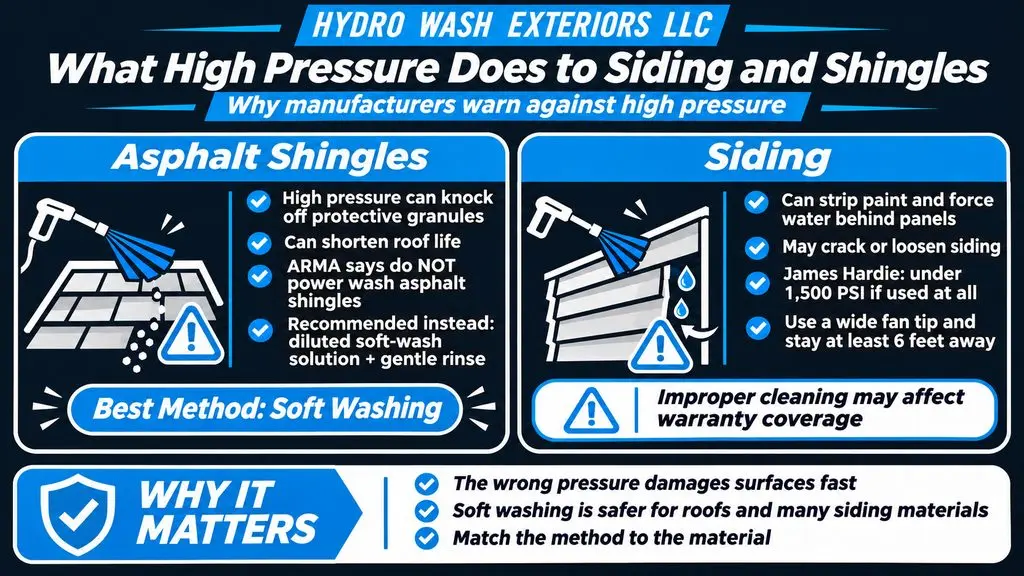
For roofs, the Asphalt Roofing Manufacturers Association is clear. In its technical bulletin on roof algae, ARMA tells homeowners not to use a power washer on asphalt shingles and warns that high-pressure systems are likely to damage the roofing. It recommends a diluted sodium hypochlorite solution, gently applied and gently rinsed, which is soft washing. That is why our soft-wash roof cleaning is never pressure washing. A roof is the surface high pressure ruins fastest.
Siding carries the same risk. James Hardie, which makes the fiber-cement siding common on newer homes here, says in its fiber-cement maintenance guidance that if a pressure washer is used at all, it should run under 1,500 PSI with a wide fan tip and stay at least six feet from the wall. It also notes that damage from improper cleaning may not be covered by the siding warranty. You will find online advice claiming vinyl can handle 2,500 PSI or more, and that is the kind of guesswork that cracks panels and forces water behind them. When the manufacturer publishes a number, that is the one to trust.
Why the Green and Black Keep Coming Back in Fayetteville
The green film and black streaks on Fayetteville homes are living algae and mildew fed by the humid Sandhills climate, so rinsing them off with plain water leaves the growth ready to return. Hot, humid summers, mild winters, and steady rain mean growth season barely stops here, and the shaded, north-facing walls stay damp longest, which is why they almost always look the worst.
The black streaking on roofs has a name. ARMA identifies the culprit as an algae called Gloeocapsa magma, and notes that roof algae is most widespread along the Eastern Seaboard, especially in warm, humid conditions. That describes Fayetteville precisely. This is also the core reason method matters. Pressure washing removes what you can see, but the organism stays alive in the surface and comes back. A soft wash kills it, so the clean lasts, and it is part of why we can stand behind a house wash the way we do.
How We Protect Your Plants and Home During a Soft Wash
Soft-wash solution is safe around your plants, pets, and family when the landscaping is protected and the mix is dialed to the surface, and protecting it is a standard part of every job, not an upsell. We pre-wet the plants before anything goes on, keep them wet and neutralized throughout, and rinse everything with fresh water at the end. The mix itself is metered to your siding rather than run at full strength. Here is how a wash goes, start to finish:
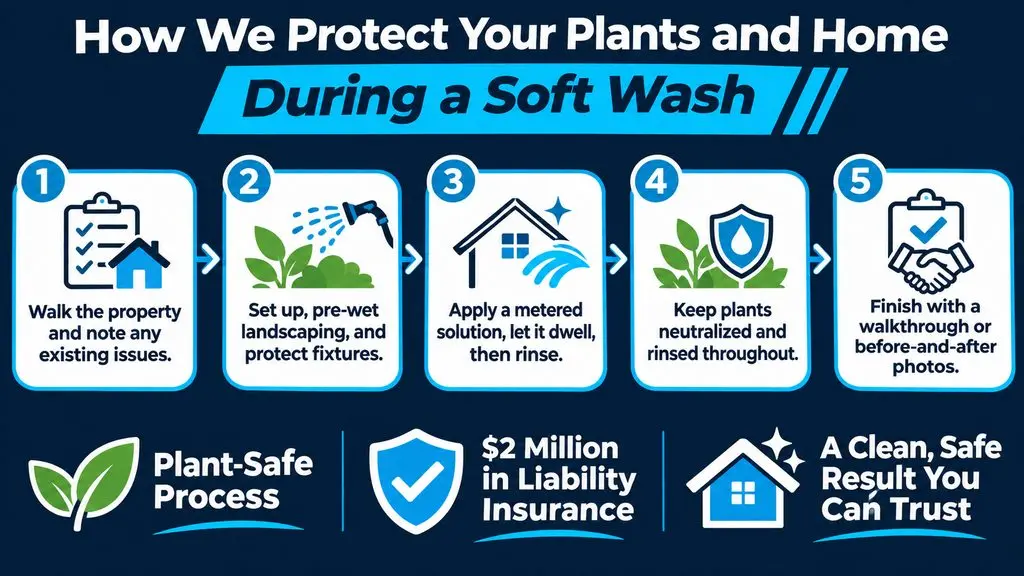
- We walk the property with you and note any pre-existing damage.
- We lay out hoses, pre-wet the plants, and cover outlets, fixtures, and doorbells.
- We work two sides of the home at a time: apply, let it dwell, then rinse with fresh water.
- A ground tech keeps a neutralizer on the plants the whole time.
- We finish with a walkthrough together, or before-and-after photos if you are not home.
That walkthrough matters to us. We explain exactly what we will do before we start, and we finish by looking at the results with you so you can tell us you are happy. We are also fully insured, carrying $2 million in general liability coverage, so you are covered from the moment we pull into the driveway.
When Neither Method Is the Right Answer
Some exterior problems need a repair or a restoration rather than a wash, and we will tell you that before we start instead of washing a surface that will not come back. Saying so up front is part of how we work, even when it means turning down the job.
Failing paint. Homes with peeling, failing, or improperly applied paint may not be good candidates for washing. We will assess it and tell you honestly before we proceed, because a wash can lift paint that was already letting go.
Oxidized metal roofs. A heavily oxidized metal roof needs a restoration process, not a wash. That is a different service we do not take on, so we will let you know if that is what your roof needs. Plenty of homeowners assume a chalky, sun-faded metal roof will come clean under pressure, and it will not.
Worn-out shingles. If a roof’s shingles have lost their granules or the surface is not safe to work on, we will decline rather than risk damaging the roof.
New concrete. If concrete is newly poured, under about two years old and not yet sealed, we will not surface clean it, so we do not damage a surface that has not fully cured.
Frequently Asked Questions
How much does it cost to soft wash a house in Fayetteville?
A soft-wash house wash with us runs $200 to $550, priced by the square footage and size of your home. For what moves a quote up or down and how the other services are priced, see our full breakdown of pressure washing costs in Fayetteville.
Is soft washing worth the money?
For most Fayetteville homes, yes, because a soft wash costs far less than repairing the damage high pressure can do, and it lasts longer than a plain rinse. Our house washing is guaranteed for 18 to 24 months, and if anything is not right, you have 30 days to tell us and we will make it right. Against a median home value around $171,900 here, per the U.S. Census Bureau, a wash is a small cost to protect the siding and roof you already paid for.
How often should a house be soft washed?
It depends on shade, trees, and which side of the house you are looking at, since the shaded north side usually shows growth first. After we wash your home, we will tell you what schedule makes sense for it rather than put every house on the same calendar.
Do you rinse the roof after soft washing?
It depends on the roof and the conditions. Sometimes we rinse on site, and sometimes we let the next rain finish clearing it, but either way we keep the plants below rinsed and protected throughout the job.
Can I rent a pressure washer and do my own siding?
You can, but rental machines run at pressures that siding and roofing manufacturers warn against, and plain water will not kill the growth that is actually staining the surface. If you try it anyway, read your siding manufacturer’s care guidance first, never put a pressure washer on the roof, and protect your plants before using any cleaner.
Get a Straight Answer for Your Home in Fayetteville
The method should follow the surface, and on most Fayetteville homes that means a soft wash on the siding and roof and a surface cleaner on the concrete. If you are not sure what your home needs, we will look at it and tell you surface by surface, including the cases where something needs more than a wash. Call or text us at (910) 992-7271, or email travis@hydrowashexteriorsllc.com, and we will get you a straight answer and a fast quote.
